


Webinar IamSMEofIndia…. Zoom Sangeet Gupta 5th Sept 2026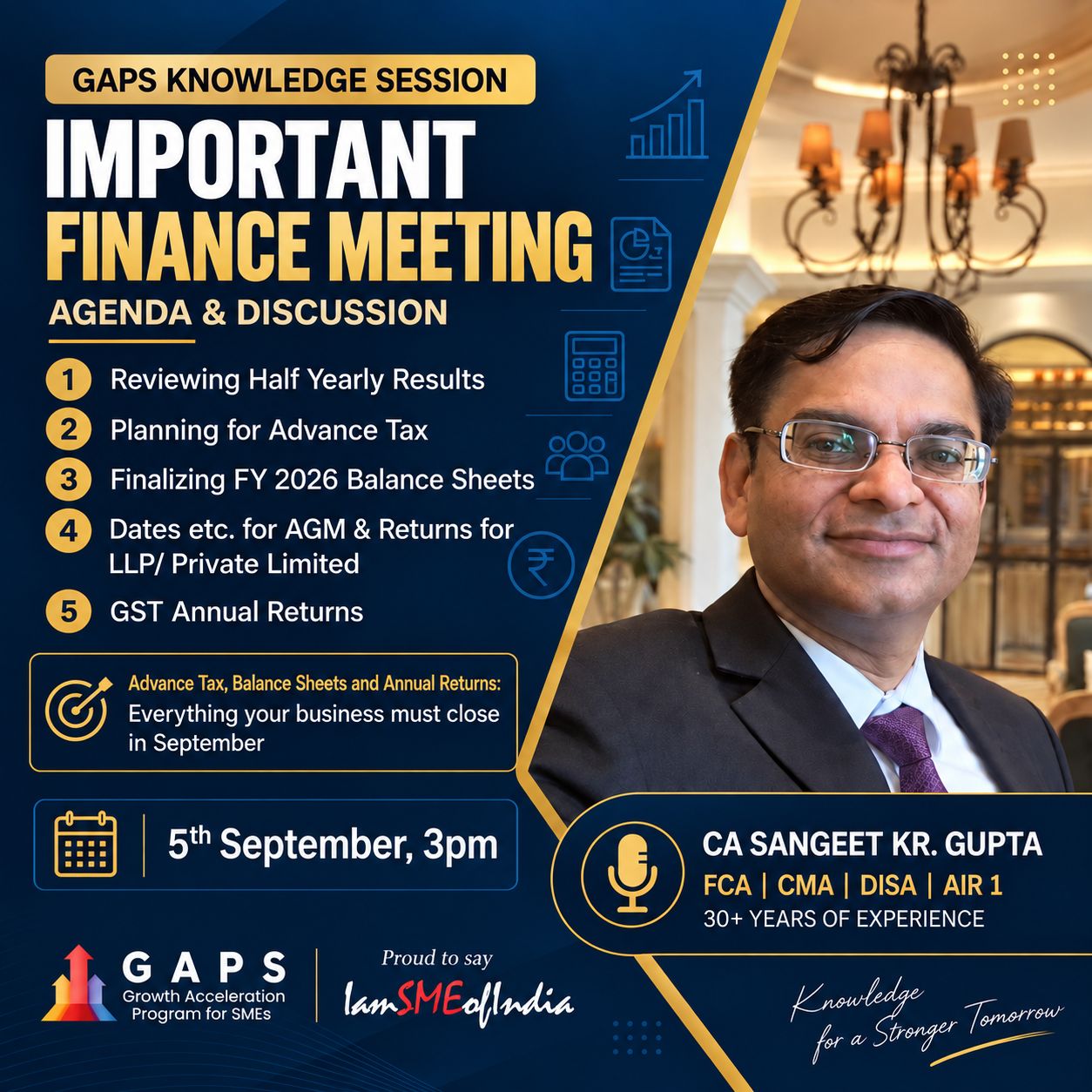

Practical Finance Meeting for MSMEs
Are you in control of your business numbers?
For many business owners, September is not just another month. It is the time to review the financial position of the business, estimate tax liability, prepare for statutory compliances, and take corrective action before the year-end rush begins.
The GAPS Knowledge Session: Finance Meeting, organised in collaboration with the Integrated Association of Micro, Small and Medium Enterprises of India, is designed as a practical working session for entrepreneurs, directors, partners and professionals.
This is not a routine lecture on accounting theory. It is an opportunity to review your own numbers, identify risks and understand what needs to be discussed with your CA, accountant or finance team.
What will be covered?
1. Advance tax planning
The September advance-tax instalment is an important checkpoint for every profitable business and individual with taxable income.
Participants will understand:
- Who is required to pay advance tax.
- How to estimate the full-year tax liability from half-yearly results.
- How to adjust TDS and TCS already deducted or expected during the year.
- How to calculate the September instalment.
- How business profit, capital gains, interest income and other sources affect tax liability.
- How underpayment can result in interest costs.
The normal instalment schedule requires cumulative payment of approximately 15% by 15 June, 45% by 15 September, 75% by 15 December and 100% by 15 March, subject to the applicable provisions and taxpayer category.
Participants will be shown practical methods to estimate advance tax for different situations, including a small MSME, an individual earning capital gains and a medium-sized company.
The objective is simple: do not wait until the return-filing season to discover that a large tax payment is payable.
2. Reviewing half-yearly numbers
A business owner should not look only at sales and bank balance. The real financial health of the business is visible through profitability, working capital, debt and cash-flow indicators.
The session will explain how to review:
- Gross profit and net profit margins.
- Current ratio and liquidity.
- Debt-equity ratio.
- Debtor turnover and receivable ageing.
- Creditor turnover and payment patterns.
- Debt-service coverage ratio.
- Inventory movement.
- Cash generated from business operations.
For example, if the net profit ratio was consistently 5% for the last five years but has fallen to 1% this year, the owner should investigate the reason. It may be due to reduced selling prices, higher raw-material costs, increased salaries, finance costs, abnormal expenses or incorrect accounting.
Similarly, if the debt-equity ratio has increased from 2:1 to 4:1 after new borrowings, the business should examine whether the loans were used for productive assets, working capital, personal withdrawals or to cover operating losses.
Ratios are not merely figures prepared for a bank or annual report. They are early-warning signals for the business owner.
3. AGM and annual ROC compliance
Companies must plan their Annual General Meeting well in advance. For most companies, the AGM for FY 2025–26 is required to be held by 30 September 2026, subject to applicable provisions and exceptions.
The session will cover practical questions such as:
- Who is required to conduct an AGM?
- Who prepares the AGM notice?
- What is the appropriate notice period?
- Can notice be sent by email, post or both?
- When is shorter notice permitted?
- Who should attend the AGM?
- How should attendance be recorded?
- What minutes and resolutions need to be maintained?
- How should multiple companies sharing the same CA or professional team schedule their AGMs?
All companies cannot realistically hold their meetings at the same time on 30 September. Directors and professionals should therefore prepare a clear calendar, finalise the financial statements and schedule meetings in a practical sequence.
After the AGM, companies must also plan their ROC filings:
- AOC-4: generally within 30 days of the AGM.
- MGT-7 or MGT-7A: generally within 60 days of the AGM.
The session will help business owners understand that conducting the AGM is only one part of the process. Proper notices, attendance records, minutes, resolutions and post-AGM filings are equally important.
4. Registered-office compliance and MGT-7
MCA compliance is becoming increasingly data-driven and verification-oriented. Businesses should ensure that their registered-office details are accurate and consistent across MCA records, GST registration, bank records, invoices and other official documents.
The revised annual-return process has increased attention on registered-office information, including the need to keep a clear photograph of the premises and relevant location details ready where required by the form and portal.
The registered office should have:
- A valid and complete address.
- A visible company name board.
- Proper records and documents.
- Consistency with the address reported to MCA.
- Evidence that the office is operational and accessible.
A company should not treat the registered office as merely a postal address. Incorrect, dormant or unverifiable premises can create serious compliance concerns.
5. LLP compliance and business structure
The session will also discuss important LLP compliances, including:
- Form 8: Statement of Account and Solvency, generally due by 30 October.
- Form 11: Annual Return, generally due by 30 May.
- The difference between company and LLP compliance.
- Situations in which an LLP may be suitable.
- Situations in which a private limited company may be more appropriate.
- Practical considerations relating to ownership, funding, liability, compliance cost and succession.
Choosing between a proprietorship, partnership, LLP and private limited company should not be based only on registration cost. The decision should consider taxation, liability protection, investment plans, governance, continuity and the future growth of the business.
6. GST annual return and e-way bill reconciliation
GSTR-9 preparation should not be postponed until the last month. The process becomes easier when the business starts reconciling its books and GST returns immediately after finalising the accounts.
Important reconciliations include:
- Turnover as per books versus GSTR-1.
- Turnover as per books versus GSTR-3B.
- Input tax credit as per books versus GSTR-2B.
- Credit notes and debit notes.
- Reverse-charge transactions.
- Exempt, nil-rated and non-GST supplies.
- HSN-wise reporting.
- State-wise turnover and tax liability.
The session will also highlight e-way bill controls. Businesses involved in movement of goods should ensure that no consignment moves without the required documentation. E-way bills should be reviewed regularly, ideally daily for high-volume businesses or at least monthly for smaller businesses.
A periodic reconciliation can identify cancelled, expired, duplicated or unused e-way bills and help prevent future queries.
7. Balance-sheet review before approval
Before signing off the financial statements, business owners should discuss key items with their finance team and CA:
- Accrued professional, audit and legal fees.
- Bonus, incentives, gratuity and leave encashment.
- Depreciation and fixed-asset additions or disposals.
- Physical verification of inventory and fixed assets.
- Old computers, laptops and electronic waste.
- Director remuneration and related-party transactions.
- Director loans and debit balances.
- Pending litigation and tax notices.
- Bank reconciliation.
- GST and TDS reconciliations.
- Current-tax provision and applicable tax adjustments.
Unpaid director remuneration, personal expenses paid by the company, large withdrawals and non-moving loan balances should be reviewed and regularised wherever necessary.
8. ROC Amnesty and compliance clean-up
The Companies Compliance Facilitation Scheme, 2026, popularly referred to as the ROC Amnesty Scheme, provides an opportunity to regularise eligible delayed ROC filings at substantially reduced additional fees.
The latest reported deadline is 15 September 2026.
Eligible delayed filings may include forms such as AOC-4, MGT-7/MGT-7A, ADT-1, DIR-12, INC-22 and other applicable statutory forms, subject to the scheme conditions. The scheme has been described as providing a substantial waiver of additional fees for eligible filings.
Companies with old filing defaults should immediately:
- Download the master data and filing history.
- Identify all pending forms.
- Check whether financial statements and annual returns are missing.
- Verify director and registered-office details.
- Prepare the forms and attachments.
- File before the scheme deadline.
This may be a valuable last opportunity for companies to complete their compliance records before normal additional fees and enforcement measures resume.
Attend with your numbers
Participants are encouraged to keep the following information available during the session:
- Sales and expenses for the first half of the year.
- Estimated full-year profit.
- TDS and TCS details.
- Advance-tax payments.
- Debtor and creditor ageing.
- Loan balances and repayment schedules.
- GST turnover and input-credit figures.
- Pending ROC filings.
- Registered-office details.
- Details of related-party transactions.
The purpose of the meeting is to help you ask better questions, understand your own financial position and take timely action.
Good financial management is not simply about filing returns. It is about knowing where your business stands before making the next important decision.
Register or learn more through the webinar : MLG Associates webinar page
This content is for general awareness and should be read with the applicable law, notifications, circulars and facts of each business.
akhil goyal (5 Sep 2026, 4:33 PM)
thanks a lot sir
for elaborating
akhil goyal (5 Sep 2026, 4:34 PM)
ok sir, thanks.
RIKKI (5 Sep 2026, 4:35 PM)
YES SIR
akhil goyal (5 Sep 2026, 4:39 PM)
ok
You (5 Sep 2026, 4:42 PM)
https://mlgassociates.in/section-80jjaa-tax-benefits-must-avail-in-new-regime-also
Use this
Shubham Verma (5 Sep 2026, 4:59 PM)
https://gapsindia.com/
Tarun Yadav (5 Sep 2026, 5:12 PM)
Great session sir
MAN MOHAN BHATIA (5 Sep 2026, 5:12 PM)
VERY VERY GOOD
Mihir Vadgama (5 Sep 2026, 5:14 PM)
Very informative , thank you sangeet Gupta sir. Great session sir
