ISD input service distributor which category of bills to shift to ISD GSTIN ?
For an Input Service Distributor (ISD), vendors should bill the ISD GSTIN only for third-party input services that are procured centrally and used by/benefit two or more GSTINs under the same PAN. If a service is used exclusively by one factory GSTIN, it should continue to be billed to that factory GSTIN.
Security services, housekeeping, facility management at head office/corporate office
Corporate-office services support multiple units
Membership fees, professional subscriptions, industry-body subscriptions
Membership is in company name and benefits all units
Market research, data analytics, business intelligence, rating/credit-report charges
Used for company-wide decisions
Bank charges for corporate/current accounts, loan-processing/professional fees relating to group finance
Only where the charge is genuinely an input service benefiting multiple GSTINs; review each case
Repair & maintenance AMC for common corporate assets
Asset/service supports multiple units
Testing, analysis, certification charges
Benefit multiple units/products
Freight/logistics-related service charges
Only if centrally procured as an input service and used by multiple GSTINs; goods and freight need separate analysis
These categories are commonly identified as ISD-eligible common services, including audit, legal/professional, software, cloud, advertising, HR, IT, telecom, insurance, and consultancy services.
Expenses that should normally remain on factory GSTIN
Raw material, packing material, consumables, spares, tools, capital goods purchased for one factory.
Factory-specific electricity, water, fuel, rent, property tax, municipal charges.
Factory-level labour contract, security, housekeeping, canteen, transport used solely by that factory.
Services used exclusively by one GSTIN, even if the invoice is received at head office. Such invoices should be billed directly to that consuming GSTIN rather than ISD.[taxguru][hnallp]
Practical vendor instruction
Ask vendors to issue invoices as follows:
Invoice to: [Company Legal Name] — Input Service Distributor GSTIN: [ISD GSTIN] Service description: Clearly mention the service and period. Place of supply / billing location: As applicable under GST. Note: This invoice relates to common/group-level input services and will be distributed through ISD.
Also update vendor master data, agreements, POs, and recurring billing instructions so that vendors report the invoice under the ISD GSTIN in GSTR-1; otherwise the credit will not correctly appear for ISD distribution.
Important caution
Do not mechanically shift every indirect expense to ISD. The test is whether the invoice is for an input service, received centrally, and attributable to another GSTIN or two or more GSTINs under the same PAN. Goods, capital goods, blocked credits, and services used exclusively by one unit should not be routed through ISD.
At MLG Associates, our name represents more than an acronym—it reflects our multidisciplinary approach to corporate finance, statutory compliance, tax advisory, and enterprise resource management.
Operating at the intersection of regulatory governance and operational technology, MLG Associates serves as a trusted partner for growing businesses, industrial enterprises, and corporate groups. Below is a detailed breakdown of what the MLG acronym stands for within our practice, highlighting the specific skills, services, and execution capabilities we deliver to our clients.
1. Maximise
M = Maximizing Compliance & Tax Efficiency
The first pillar of MLG Associates focuses on robust statutory alignment, financial governance, and strategic tax planning across direct and indirect taxation systems.
Our practice handles comprehensive direct tax administration for private limited companies, firms, and high-net-worth individuals.
Corporate Tax Planning: Structuring business operations to optimize tax liabilities within the framework of the Income Tax Act, 1961.
Scrutiny & Assessment Representation: Representing clients before Income Tax authorities, drafting submissions, and handling appellate matters.
International Taxation & Transfer Pricing: Assistance with cross-border transactions, Form 15CA/CB certifications, and transfer pricing documentation.
GST & Indirect Tax Advisory
We manage end-to-end GST frameworks to eliminate leakage and ensure seamless Input Tax Credit (ITC) flow.
GST Health Checks & Audits: Periodic reconciliation of GSTR-1, GSTR-3B, and GSTR-2B to prevent mismatches and statutory notices.
Departmental Representations: Drafting replies and managing proceedings for show-cause notices (SCNs) and departmental audits under GST.
Statutory Audits & Governance
Under strict adherence to ICAI Standards on Auditing (SAs), our firm carries out independent assurance engagements:
Statutory Financial Audits: Independent verification of financial statements under the Companies Act, 2013.
Tax Audits (Section 44AB): Comprehensive examination of books of accounts for tax compliance.
Internal Financial Controls (IFC): Reviewing and testing internal control mechanisms across enterprise workflows.
2. Leverage
L = Leveraging Business Technology & Outsourced CFO Services
Modern financial control requires more than traditional bookkeeping; it demands deep operational integration with accounting technologies, Enterprise Resource Planning (ERP) tools, and structured management oversight.
Enterprise Accounting & Financial Systems (Finsys ERP & Tally)
MLG Associates holds specialized experience in aligning accounting protocols with industrial manufacturing workflows and ERP systems (such as Finsys ERP and Tally Prime).
ERP System Implementation & Audit: Assisting manufacturing clients in setting up financial modules, inventory flow tracking, and BOM (Bill of Materials) costing within Finsys and similar ERP systems.
Chart of Accounts (CoA) Standardization: Designing structured ledgers and cost-center accounting architectures for multi-plant manufacturing operations.
ERP Data Reconciliation: Independent validation of inventory movements, production logs, and financial postings within enterprise software.
Virtual CFO & Financial Management Support
For mid-sized corporates and industrial groups requiring senior-level financial direction without a full-time in-house executive:
Cash Flow Management & Treasury: Working capital monitoring, fund-flow projections, and liquidity management.
MIS & Operational Reporting: Preparing customized monthly Management Information System (MIS) reports, profitability segmentations, and variance analyses.
Budgeting & Variance Control: Establishing annual operating budgets and tracking cost overruns across business units.
G = Driving Enterprise Growth, Project Finance & Structuring
The third dimension of MLG Associates centers on enabling corporate expansion, project finance modeling, debt syndication, and financial risk advisory.
We assist industrial clients in securing debt capital and structured credit facilities for expansion, greenfield projects, and working capital needs:
Detailed Project Reports (DPR): Drafting technical and financial feasibility reports for banking institutions and credit committees.
CMA Data Preparation: Preparing Credit Monitoring Arrangement (CMA) data, projected cash flow statements, and debt service coverage ratio (DSCR) calculations for working capital and term loan appraisals.
Bank Representation & Credit Assessment: Facilitating communication with financial institutions during credit appraisal and loan documentation processes.
Capital Restructuring & Business Valuations
Corporate Restructuring: Advising on capital structure optimization, debt-to-equity ratios, and financial re-engineering.
Business & Asset Valuation: Conducting financial valuations for legal, compliance, tax, or investment purposes using DCF (Discounted Cash Flow) and asset-based methodologies.
Transaction Advisory & Due Diligence: Performing buy-side or sell-side financial due diligence for business acquisitions or joint ventures.
Service Matrix: Core Competencies at a Glance
Pillar
Service Category
Practical Skills & Execution Capabilities
Maximizing Compliance
Direct Taxation
Income Tax filings, Scrutiny Appeals, Transfer Pricing, Form 15CA/CB.
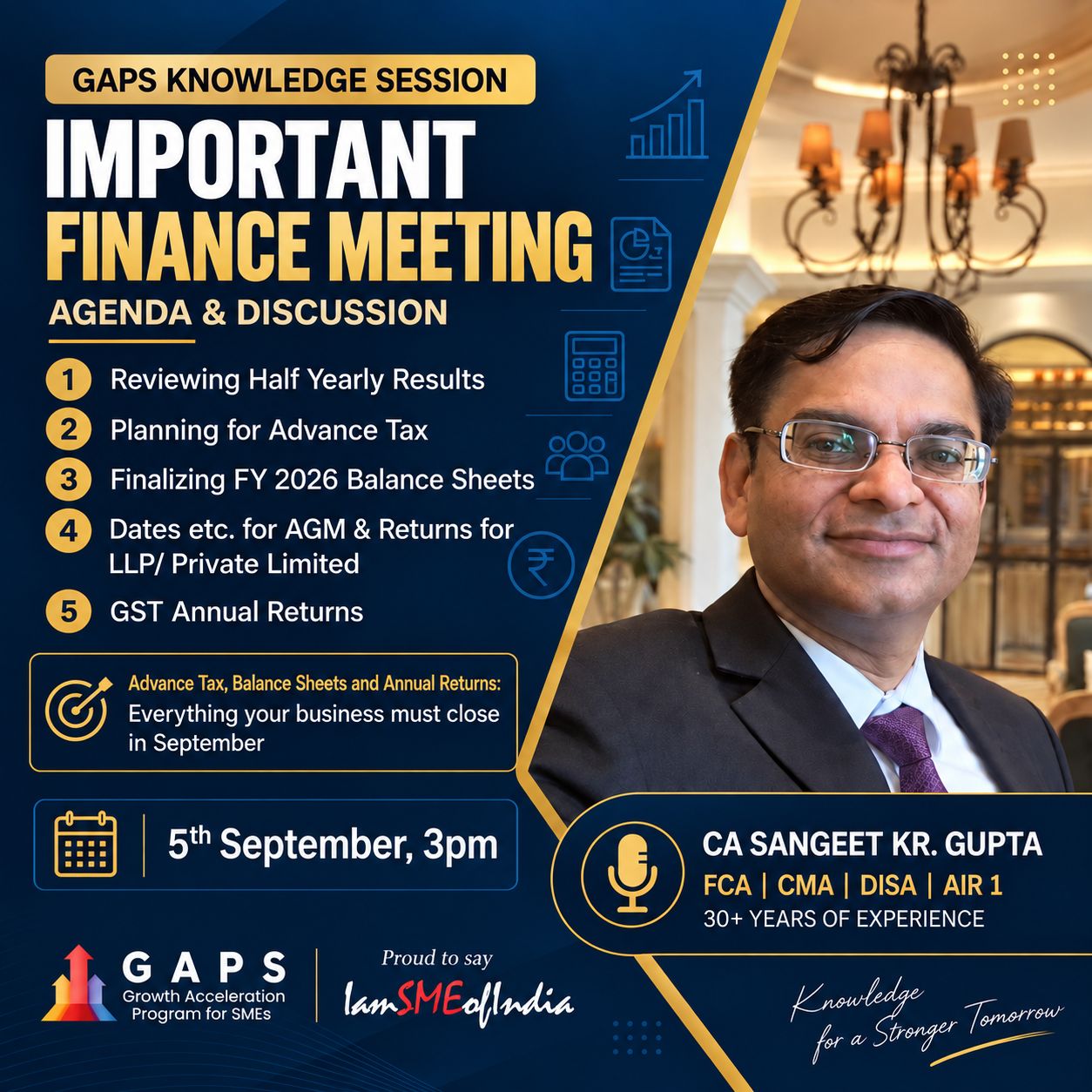
For many business owners, September is not just another month. It is the time to review the financial position of the business, estimate tax liability, prepare for statutory compliances, and take corrective action before the year-end rush begins.
The GAPS Knowledge Session: Finance Meeting, organised in collaboration with the Integrated Association of Micro, Small and Medium Enterprises of India, is designed as a practical working session for entrepreneurs, directors, partners and professionals.
This is not a routine lecture on accounting theory. It is an opportunity to review your own numbers, identify risks and understand what needs to be discussed with your CA, accountant or finance team.
What will be covered?
1. Advance tax planning
The September advance-tax instalment is an important checkpoint for every profitable business and individual with taxable income.
Participants will understand:
Who is required to pay advance tax.
How to estimate the full-year tax liability from half-yearly results.
How to adjust TDS and TCS already deducted or expected during the year.
How to calculate the September instalment.
How business profit, capital gains, interest income and other sources affect tax liability.
How underpayment can result in interest costs.
The normal instalment schedule requires cumulative payment of approximately 15% by 15 June, 45% by 15 September, 75% by 15 December and 100% by 15 March, subject to the applicable provisions and taxpayer category.
Participants will be shown practical methods to estimate advance tax for different situations, including a small MSME, an individual earning capital gains and a medium-sized company.
The objective is simple: do not wait until the return-filing season to discover that a large tax payment is payable.
2. Reviewing half-yearly numbers
A business owner should not look only at sales and bank balance. The real financial health of the business is visible through profitability, working capital, debt and cash-flow indicators.
The session will explain how to review:
Gross profit and net profit margins.
Current ratio and liquidity.
Debt-equity ratio.
Debtor turnover and receivable ageing.
Creditor turnover and payment patterns.
Debt-service coverage ratio.
Inventory movement.
Cash generated from business operations.
For example, if the net profit ratio was consistently 5% for the last five years but has fallen to 1% this year, the owner should investigate the reason. It may be due to reduced selling prices, higher raw-material costs, increased salaries, finance costs, abnormal expenses or incorrect accounting.
Similarly, if the debt-equity ratio has increased from 2:1 to 4:1 after new borrowings, the business should examine whether the loans were used for productive assets, working capital, personal withdrawals or to cover operating losses.
Ratios are not merely figures prepared for a bank or annual report. They are early-warning signals for the business owner.
3. AGM and annual ROC compliance
Companies must plan their Annual General Meeting well in advance. For most companies, the AGM for FY 2025–26 is required to be held by 30 September 2026, subject to applicable provisions and exceptions.
The session will cover practical questions such as:
Who is required to conduct an AGM?
Who prepares the AGM notice?
What is the appropriate notice period?
Can notice be sent by email, post or both?
When is shorter notice permitted?
Who should attend the AGM?
How should attendance be recorded?
What minutes and resolutions need to be maintained?
How should multiple companies sharing the same CA or professional team schedule their AGMs?
All companies cannot realistically hold their meetings at the same time on 30 September. Directors and professionals should therefore prepare a clear calendar, finalise the financial statements and schedule meetings in a practical sequence.
After the AGM, companies must also plan their ROC filings:
AOC-4: generally within 30 days of the AGM.
MGT-7 or MGT-7A: generally within 60 days of the AGM.
The session will help business owners understand that conducting the AGM is only one part of the process. Proper notices, attendance records, minutes, resolutions and post-AGM filings are equally important.
4. Registered-office compliance and MGT-7
MCA compliance is becoming increasingly data-driven and verification-oriented. Businesses should ensure that their registered-office details are accurate and consistent across MCA records, GST registration, bank records, invoices and other official documents.
The revised annual-return process has increased attention on registered-office information, including the need to keep a clear photograph of the premises and relevant location details ready where required by the form and portal.
The registered office should have:
A valid and complete address.
A visible company name board.
Proper records and documents.
Consistency with the address reported to MCA.
Evidence that the office is operational and accessible.
A company should not treat the registered office as merely a postal address. Incorrect, dormant or unverifiable premises can create serious compliance concerns.
5. LLP compliance and business structure
The session will also discuss important LLP compliances, including:
Form 8: Statement of Account and Solvency, generally due by 30 October.
Form 11: Annual Return, generally due by 30 May.
The difference between company and LLP compliance.
Situations in which an LLP may be suitable.
Situations in which a private limited company may be more appropriate.
Practical considerations relating to ownership, funding, liability, compliance cost and succession.
Choosing between a proprietorship, partnership, LLP and private limited company should not be based only on registration cost. The decision should consider taxation, liability protection, investment plans, governance, continuity and the future growth of the business.
6. GST annual return and e-way bill reconciliation
GSTR-9 preparation should not be postponed until the last month. The process becomes easier when the business starts reconciling its books and GST returns immediately after finalising the accounts.
Important reconciliations include:
Turnover as per books versus GSTR-1.
Turnover as per books versus GSTR-3B.
Input tax credit as per books versus GSTR-2B.
Credit notes and debit notes.
Reverse-charge transactions.
Exempt, nil-rated and non-GST supplies.
HSN-wise reporting.
State-wise turnover and tax liability.
The session will also highlight e-way bill controls. Businesses involved in movement of goods should ensure that no consignment moves without the required documentation. E-way bills should be reviewed regularly, ideally daily for high-volume businesses or at least monthly for smaller businesses.
A periodic reconciliation can identify cancelled, expired, duplicated or unused e-way bills and help prevent future queries.
7. Balance-sheet review before approval
Before signing off the financial statements, business owners should discuss key items with their finance team and CA:
Accrued professional, audit and legal fees.
Bonus, incentives, gratuity and leave encashment.
Depreciation and fixed-asset additions or disposals.
Physical verification of inventory and fixed assets.
Old computers, laptops and electronic waste.
Director remuneration and related-party transactions.
Director loans and debit balances.
Pending litigation and tax notices.
Bank reconciliation.
GST and TDS reconciliations.
Current-tax provision and applicable tax adjustments.
Unpaid director remuneration, personal expenses paid by the company, large withdrawals and non-moving loan balances should be reviewed and regularised wherever necessary.
8. ROC Amnesty and compliance clean-up
The Companies Compliance Facilitation Scheme, 2026, popularly referred to as the ROC Amnesty Scheme, provides an opportunity to regularise eligible delayed ROC filings at substantially reduced additional fees.
The latest reported deadline is 15 September 2026.
Eligible delayed filings may include forms such as AOC-4, MGT-7/MGT-7A, ADT-1, DIR-12, INC-22 and other applicable statutory forms, subject to the scheme conditions. The scheme has been described as providing a substantial waiver of additional fees for eligible filings.
Companies with old filing defaults should immediately:
Download the master data and filing history.
Identify all pending forms.
Check whether financial statements and annual returns are missing.
Verify director and registered-office details.
Prepare the forms and attachments.
File before the scheme deadline.
This may be a valuable last opportunity for companies to complete their compliance records before normal additional fees and enforcement measures resume.
Attend with your numbers
Participants are encouraged to keep the following information available during the session:
Sales and expenses for the first half of the year.
Estimated full-year profit.
TDS and TCS details.
Advance-tax payments.
Debtor and creditor ageing.
Loan balances and repayment schedules.
GST turnover and input-credit figures.
Pending ROC filings.
Registered-office details.
Details of related-party transactions.
The purpose of the meeting is to help you ask better questions, understand your own financial position and take timely action.
Good financial management is not simply about filing returns. It is about knowing where your business stands before making the next important decision.
How Finsys and MLG Help You Stay in Control ~ MLG Finsys MIS Reports Package
A Practical MIS Review for Business Owners
Running an MSME is not only about increasing sales. It is also about knowing.…at the right time:
– How much money has been collected today. ?
– Which customers are overdue. ?
– What is lying in the bank. ?
– Which payments are pending ?.
– Which materials are moving slowly ?.
– Whether GST and TDS obligations are ready ?.
– Whether stock, sales, purchases, and cash are moving according to plan ?.
Many business owners receive information only at month-end. By then, a delayed collection, excess inventory, missed GST invoice, wrong purchase rate, or unapproved payment may already have affected profitability.
The purpose of this MIS review is simple:
> “To give the MD ready-to-use information so that important decisions do not depend only on assumptions,telephone calls, or delayed reports.”
Come,… Let us start
Finsys provides the system visibility. MLG Associates helps interpret the information, identify risks, and guide the management team.
Together, they help create a practical **MD Control Room** for your business.
***
What You Can Expect From This Review
This is not merely a software demonstration.
During the personal meeting, our team will help you understand:
1. What information the MD should receive daily, weekly, and monthly. 2. Which reports are already available in your Finsys system. 3. Which reports require better data entry or process discipline. 4. What business risks each report can reveal. 5. Which person in your organisation should act on the information. 6. How regular review can improve cash flow, working capital, compliance, stock control, and profitability.
The objective is not to create more reports.
The objective is to create better decisions with fewer surprises.
1. Daily MD Snapshot
Daily reports are designed to give the MD a quick view of the current position.
Sales Position
The MD can review:
– Sales for today.
– Sales for the current month up to date.
– Sales for the current financial year.
– Comparison with the corresponding period of the previous year.
– Sales by customer, salesperson, product, branch, or location, wherever applicable.
Why it matters
A sales figure by itself is not enough. Management should also know whether sales are growing, whether the growth is profitable, and whether collections are keeping pace with sales.
Questions for the MD
– Are we achieving our daily and monthly sales plan?
– Which products or customers are contributing to the growth?
– Is sales growth coming with healthy margins?
– Are sales increasing while collections are slowing down?
Collection Position
The collection report may show:
– Collections received today.
– Collections received during the month.
– Collections during the financial year.
– Comparison with the previous year.
– Customer-wise collections.
– Salesperson-wise or territory-wise collection performance.
Why it matters
Profit shown in the Profit & Loss Account does not automatically mean cash has been received.
A business may show strong sales and profit but still face pressure because receivables are not collected on time.
**Questions for the MD**
– Which major customers have not paid as expected?
– Are salespeople following up for collections?
– Are customer advances properly adjusted?
– Are deductions and short payments being identified quickly?
***
Bank Ledger and Bank Position
The MD should receive a clear view of:
– Bank balances.
– Receipts and payments.
– Cheques issued but not presented.
– Cheques deposited but not cleared.
– Bank-wise position.
– Available drawing power or working capital position, where applicable.
Why it matters
A bank balance is not always the same as immediately available cash.
The business may have:
– Cheques issued but not yet presented.
– Customer cheques under clearing.
– Bank charges not recorded.
– Receipts credited in the bank but not adjusted in the books.
– Temporary funds available in one bank but shortages in another.
***
Bank Reconciliation
Bank reconciliation should help identify:
– Deposits recorded in the books but not yet credited by the bank.
– Payments recorded in the books but not yet presented.
– Bank charges and interest not entered in the books.
– Direct credits or debits appearing in the bank statement.
– Unidentified transactions.
– Old uncleared items requiring follow-up.
Why it matters
Regular reconciliation reduces the risk of:
– Duplicate payments.
– Missing receipts.
– Incorrect bank balances.
– Delayed detection of unauthorised transactions.
– Incorrect cash-flow decisions.
***
Suspense Accounts
The team should review suspense receipts and suspense payments regularly.
**The review should ask:**
– Why has the amount not been identified?
– Which customer, supplier, employee, or bank account is involved?
– Who is responsible for resolving it?
– How long has the amount remained pending?
– Is there a possibility of duplicate payment or incorrect accounting?
**MD benefit**
Suspense accounts are not merely an accounting issue. They may hide:
– Payments approved but not released.
– Payments awaiting approval.
– Supplier bills received but not processed.
– Bills pending because of missing purchase orders, goods receipt, quality approval, or supporting documents.
Why it matters
This helps management balance two priorities:
– Paying suppliers on time.
– Avoiding premature or duplicate payments.
Instead of asking different departments for separate updates, the MD receives one structured daily snapshot.
***
2. Weekly “Working-Capital” Review : Debtors and creditors
Weekly reports help management control money blocked in customers, suppliers, stock, advances, and pending transactions.
Customer Outstanding: 30–60–90–120–150–180 Days
The report should be reviewed:
– Customer-wise.
– Salesperson-wise.
– Branch-wise.
– Ageing-wise.
– Against approved credit limits.
– Against agreed payment terms.
**Questions for the MD**
– Which customer accounts are moving beyond agreed credit terms?
– Which salesperson has the largest overdue collection?
– Are any customers continuously purchasing without clearing old dues?
– Is the business giving credit to customers who are already overdue?
***
Bills With Short Payment
This report identifies invoices where the customer has paid less than the billed amount.
A small deduction on hundreds of invoices can become a significant annual loss.
The objective is not always to recover every deduction. It is to identify recurring patterns and prevent avoidable leakage.
***
Customer Advances
Customer advances require regular review because:
– The invoice may not yet have been raised.
– GST treatment may require attention.
– The advance may relate to an old order.
– The order may have been cancelled.
– The amount may have been received against the wrong customer ledger.
**MD benefit**
This report helps the business convert advances into sales correctly and avoid old balances remaining unexplained.
***
Customer Dues Older Than 180 Days
Old receivables require special attention.
The review should classify them as:
– Recoverable.
– Under dispute.
– Subject to documentation issues.
– Financially stressed customer.
– Likely doubtful.
– Requiring legal or commercial action.
**Important caution**
The accounting and tax treatment of old receivables should be reviewed with the company’s tax and audit advisors based on the applicable facts. The report is a management-warning tool; it is not a substitute for a specific legal or tax opinion.
***
3. Supplier and MSME Payment Review
Supplier Outstanding: 30–60–90–120–150–180 Days
The MD should see supplier dues:
– Supplier-wise.
– Purchase-category-wise.
– Location-wise.
– Ageing-wise.
– Against agreed payment terms.
– Separately for disputed and undisputed balances.
– Advance paid but material not received.
– Material received but invoice not received.
– Invoice received but not adjusted against advance.
– TDS or GST documentation pending.
– Old advances requiring recovery or adjustment.
The purpose of this review is to separate genuine payable amounts from balances that require correction or settlement.
***
Supplier Dues Beyond Applicable MSME Payment Timelines
Management should identify dues that may require attention under applicable MSME payment and tax provisions.
This report should be reviewed jointly by:
– The MD.
– Purchase department.
– Accounts department.
– Finance team.
– Tax or compliance advisor.
**Why it matters**
The report helps management take action before the issue becomes:
– A supplier dispute.
– A compliance concern.
– A tax-adjustment issue.
– A cash-flow problem.
– A year-end disclosure or audit concern.
***
4. Unadjusted Receipts and Payments
Suspense Receipts and Suspense Payments
The objective is to ensure that every receipt and payment reaches the correct ledger.
**Review points**
– Is the customer or supplier identified?
– Is the amount related to an invoice?
– Is a bank narration available?
– Is there any possibility of duplicate payment?
– Has the responsible employee been assigned?
– Is the item older than the permitted resolution period?
***
On-Account Receipts
On-account receipts should be reviewed to identify:
– Customer deductions.
– Unadjusted advances.
– Invoice-wise payment allocation.
– TDS deductions.
– Short payments.
– Receipts credited to the wrong customer.
**MD benefit**
Early identification allows the company to recover genuine deductions and adjust books properly.
This provides better control over working capital and reduces the risk of funds remaining unadjusted.
***
5. GST and Documentation Control
GST Invoices Not Recorded in the Books
This review can identify invoices that may have been received operationally but are not yet recorded in accounts.
Possible reasons:
– Invoice pending from purchase department.
– Goods received but bill not received.
– Bill pending quality approval.
– Bill pending accounts entry.
– Invoice received at another location.
– Vendor has issued an incorrect invoice.
***
GST Invoices Not Appearing on the GST Portal
The team may follow up on invoices that are:
– Recorded in the books but not reflected on the portal.
– Reflected with an incorrect GSTIN.
– Reflected with an incorrect invoice number.
– Reflected with an incorrect taxable value or tax amount.
– Pending due to vendor filing or amendment.
**Why it matters**
This helps the company monitor input-tax-credit risks and follow up with suppliers in time.
The final tax treatment should always be confirmed with the responsible tax professional based on the relevant GST provisions and records.
***
Pending GST E-Invoices
The report should identify invoices requiring attention before dispatch or reporting, wherever e-invoicing provisions apply.
**Questions for management**
– Which invoices are pending?
– Is the delay due to master-data problems?
– Is the customer GSTIN valid?
– Is the HSN or tax rate correct?
– Is the invoice blocked because of a system or process issue?
– Has material already been dispatched?
***
6. Monthly Financial Review
Profit and Loss Account With Ratio Analysis
The MD should receive more than a simple P&L.
The monthly review may include:
– Sales growth.
– Gross profit percentage.
– EBITDA.
– Net profit.
– Expense ratios.
– Contribution by product.
– Contribution by customer.
– Plant or branch profitability.
– Comparison with budget and previous year.
**Questions for the MD**
– Is profit improving because of genuine efficiency or temporary factors?
– Which expenses are increasing faster than sales?
– Which product or customer has reduced margins?
– Are freight, power, salary, finance cost, or rejection costs rising?
***
Bank Stock and Debtors Statement
Where applicable, the report may support preparation and review of bank stock and debtor statements.
The team should reconcile:
– Stock as per books.
– Stock as per physical or operational records.
– Debtors as per books.
– Eligible receivables.
– Credit notes and old receivables.
– Drawing-power calculations.
**MD benefit**
This reduces the chance of differences between internal records and information submitted to financial institutions.
***
Cash Flow or Funds Flow Report
The report should help the MD understand:
– Opening cash and bank balance.
– Expected collections.
– Expected payments.
– GST and TDS outflows.
– Salaries and statutory payments.
– Loan instalments and interest.
– Purchase commitments.
– Planned capital expenditure.
– Surplus or shortage of funds.
**The key question**
> Will the business have sufficient cash when the payment actually falls due?
Profitability and cash flow must be reviewed together.
The dates shown in internal MIS should be treated as management targets and verified against the applicable statutory due dates for the relevant taxpayer and period.
***
Customer Credit Limit Versus Outstanding
This report compares:
– Approved credit limit.
– Current outstanding.
– Overdue amount.
– Pending sales orders.
– Customer advances.
– Security or collateral, where applicable.
– Proposed further sales.
**MD benefit**
The MD can make a conscious decision before allowing additional credit to a customer.
***
Early Payments to Suppliers
The report identifies purchases paid before the agreed due date.
Management can then ask:
– Was an early-payment discount received?
– Was early payment necessary?
– Was the payment made due to pressure from the supplier?
– Could the funds have been used elsewhere?
– Is the payment policy being followed?
***
Late Collection From Customers
This report compares customer collection with agreed payment terms.
These accounts should be reviewed periodically for:
– Old advances.
– Missing supporting documents.
– Unadjusted travel expenses.
– Personal or non-business payments.
– Repeated advances to the same person.
– Unused balances.
**MD benefit**
Small unadjusted balances can become large control weaknesses when repeated across the organisation.
***
Directors and Related-Party Ledger Accounts
These accounts should be reviewed for:
– Debit or credit balances.
– Unadjusted personal expenses.
– Advances.
– Business expenses paid personally.
– Transactions requiring approval or disclosure.
– Balances remaining outstanding for long periods.
The review should be performed with appropriate confidentiality and in consultation with the company’s auditor or tax advisor wherever required.
***
Bank Interest and Finance Cost Review
The team can compare:
– Sanctioned interest rate.
– Applicable rate.
– Actual interest charged.
– Penal interest.
– Processing charges.
– Commitment charges.
– Other bank charges.
– Excess charges or unexplained differences.
**MD benefit**
A small difference in interest rate or bank charges can have a significant impact on a large working-capital limit.
***
7. Production and Operations Review
Slow-Moving Finished Goods
The report should identify finished goods remaining beyond the company’s normal holding period.
**Questions for management**
– Is there confirmed demand?
– Is the product still saleable?
– Is the stock packed according to current customer requirements?
– Is the selling price adequate?
– Should a special sales plan or transfer be considered?
***
Slow-Moving Raw Materials
Raw materials beyond the defined holding period should be classified as:
– Required for confirmed orders.
– Required for regular production.
– Surplus.
– Obsolete or near-obsolete.
– Transferable to another plant or product line.
– Requiring purchase-plan revision.
**MD benefit**
The aim is to release blocked working capital before it becomes a write-off.
***
Purchased Material With Rejections
The report should track:
– Supplier name.
– Purchase order.
– Material received.
– Quantity rejected.
– Reason for rejection.
– Replacement status.
– Debit note or claim status.
– Production impact.
– Financial impact.
***
Customer Returns
Returned material should be reviewed for:
– Customer.
– Invoice.
– Quantity.
– Reason for return.
– Quality issue.
– Transport damage.
– Commercial dispute.
– Replacement or credit-note action.
– Re-entry into saleable stock.
***
Material Received in Late Hours
This report can help identify receipts occurring outside normal operating hours.
Management may review:
– Whether the purchase was approved.
– Whether the receipt was genuinely urgent.
– Whether the quality check was completed.
– Whether the entry date is correct.
– Whether there is any risk of backdated or delayed documentation.
***
Material Shipped in Late Hours
The MD may review late-hour dispatches for:
– Customer urgency.
– Transport planning.
– Sales order reference.
– Invoice and e-way documentation.
– Dispatch approval.
– Freight impact.
– Repeated exceptions by location or customer.
***
Pending Sales Orders
The report should show:
– Customer.
– Order date.
– Product.
– Quantity.
– Promised delivery date.
– Available stock.
– Production status.
– Dispatch status.
– Reason for delay.
**MD benefit**
This enables management to protect customer relationships and prioritise production intelligently.
– Supplier.
– Order value.
– Order date.
– Expected delivery date.
– Material pending.
– Advance paid.
– Production impact.
– Revised expected date.
***
8. Stock-Related MIS
Raw-Material Closing Stock
The raw-material stock report may be valued using the company’s approved method, such as actual landed cost or FIFO, subject to the company’s accounting policy and applicable reporting requirements.
Where applicable, other stock categories should be reported separately with clear definitions and valuation logic.
**Important principle**
Every stock report should clearly state:
– Quantity basis.
– Valuation basis.
– Date of report.
– Location.
– Whether the figure is book stock, physical stock, or operational stock.
– Whether rejected or blocked stock is included.
– Item.
– Quantity.
– Value.
– Date of rejection.
– Reason.
– Responsible party.
– Expected action.
– Disposal, replacement, return, or rework status.
***
Pending Quality-Control Stock
The report should identify material remaining in quality control beyond the defined number of days.
**Questions for the MD**
– Why is the material not released?
– Is the delay due to laboratory testing, documentation, manpower, or quality dispute?
– Is production waiting for the material?
– Is the material included incorrectly in available stock?
– Is supplier or customer communication required?
***
How the Personal Meeting Will Work
Step 1: Understand the MD’s Priorities
The Finsys and MLG team will first understand the MD’s key concerns, such as:
We will not overwhelm the MD with every available report.
We will select the reports most relevant to the business and demonstrate how each one answers a practical management question.
For example:
> “Which customers are using our working capital beyond the approved credit period?”
or:
> “Do we have excess raw material in one location while another location is purchasing the same item?”
***
Step 3: Explain the Business Meaning
A report is valuable only when management understands what action it requires.
For each report, the team will explain:
– What the report shows.
– Why it matters.
– What warning signs to look for.
– Who should act.
– How quickly the matter should be resolved.
– What information must be improved for better reporting.
The implementation can begin with a small number of high-value reports, such as:
1. Sales and collection position.
2. Bank position and reconciliation.
3. Customer ageing.
4. Supplier ageing.
5. Cash-flow forecast.
6. Slow-moving stock.
7. Pending purchase and sales orders.
8. GST invoice reconciliation.
9. Profitability and ratio analysis.
10. Suspense and on-account balances.
Once the MD sees the value, additional reports can be added systematically.
***
What the Client Team Must Do
Finsys and MLG can guide, configure, review, and follow up. However, accurate MIS depends on timely and correct data entry.
The client team remains responsible for:
– Entering transactions correctly.
– Creating accurate customer, supplier, item, and GST masters.
– Recording receipts and payments promptly.
– Completing purchase and sales documentation.
– Recording material receipts and dispatches.
– Completing quality and stock confirmations.
– Sharing bank statements and supporting documents.
– Assigning responsible persons for pending items.
– Providing explanations for exceptions.
> **Correct data in the system creates reliable management information.**
***
What Finsys Will Contribute
Finsys helps provide the technology platform for:
– Integrated accounting.
– Sales and purchase workflows.
– Inventory and stock visibility.
– Order tracking.
– Bank and receivable information.
– Multi-location reporting, where configured.
– Automated MIS generation.
– User-wise process discipline.
– Dashboards and management reports.
The exact reports and automation available will depend on the client’s Finsys modules, configuration, transaction discipline, and agreed scope.
***
What MLG Associates Will Contribute
MLG Associates can help the client with:
– MIS interpretation.
– Accounting and control review.
– GST and TDS follow-up.
– Receivable and payable ageing review.
– Working-capital guidance.
– Ratio and profitability analysis.
– Suspense and ledger scrutiny.
– Monthly management discussions.
– Identification of reporting gaps.
– Guidance for corrective action.
The objective is not merely to point out mistakes.
The objective is to help management understand the issue, decide the action, and monitor closure.
***
The MD’s Expected Outcome
After adopting this approach, the MD should gradually gain better visibility over:
– Daily sales.
– Daily collections.
– Cash and bank position.
– Customer and supplier exposure.
– Pending approvals.
– Stock ageing.
– Production and dispatch commitments.
– GST and TDS readiness.
– Profitability and expenses.
– Cash-flow requirements.
– Operational exceptions.
The desired outcome is:
> **Less dependence on informal updates. More control through timely, organised information.**
***
A Simple Monthly MD Meeting Agenda
1. Business Performance
– Sales versus target.
– Sales versus previous year.
– Collection versus sales.
– Gross profit and EBITDA.
– Key product and customer performance.
***
2. Cash and Working Capital
– Bank position.
– Expected collections.
– Payments due.
– Customer ageing.
– Supplier ageing.
– Advances and on-account balances.
– GST status.
– TDS status.
– Unrecorded or unmatched invoices.
– Suspense accounts.
– Bank reconciliation.
– Related-party and director balances.
***
5. Action Plan
– Issue.
– Responsible person.
– Required action.
– Due date.
– Status at the next meeting.
***
Questions the MD Should Ask Every Month
1. What is our current cash position?
2. How much collection is expected in the next 15 and 30 days?
3. Which customers are overdue beyond agreed terms?
4. Which suppliers are awaiting payment?
5. Are any MSME-related payment matters pending review?
6. What stock is moving slowly?
7. Can any excess material be used or transferred elsewhere?
8. Which purchase orders are pending receipt?
9. Which sales orders are delayed?
10. Are any customer or vendor advances old and unadjusted?
11. Are there any invoices in the books but not reflected on the GST portal?
12. Are there any GST e-invoices pending?
13. Which expenses have increased unusually?
14. Is the bank charging the agreed interest and fees?
15. Which suspense accounts are still unresolved?
16. Are any director or related-party balances outstanding?
17. What is our expected tax and statutory cash requirement?
18. Which product, customer, branch, or plant has reduced profitability?
19. Which issue requires immediate MD intervention?
20. What are the five actions to be closed before the next review?
The challenge is that important information is often:
– Spread across departments.
– Available only in separate files.
– Delayed until month-end.
– Not compared with targets.
– Not assigned to a responsible person.
– Not converted into an action plan.
A structured MIS review helps the MD move from:
> “Please find out what happened.”
to:
> “I know what is happening, why it is happening, and what action is required.”
***
Finsys + MLG: A Practical Partnership for Better Control
> **We do not want to give you more paperwork. We want to give you more control.**
***
Begin With Your Top Five Questions
Before the meeting, the MD may identify the five questions that matter most today.
For example:
– Where is my money blocked?
– Which customer is delaying payment?
– Which stock is becoming slow-moving?
– Which purchase is costing more than necessary?
– What compliance or banking issue needs immediate attention?
The Finsys and MLG team will then demonstrate how the relevant information can be organised, reviewed, and followed up.
***
Schedule Your Management Information Review
If your business has grown beyond informal registers, scattered spreadsheets, and delayed monthly information, it may be time to create a structured MD reporting system.
A personal review with the Finsys and MLG team can help you:
– Understand the current information flow.
– Identify important reporting gaps.
– Select the most relevant MIS reports.
– Define daily, weekly, and monthly reviews.
– Improve accountability across departments.
– Build a practical management-control routine.
The objective is simple:
> **To help the MD remain informed, confident, and in control—without having to personally chase every department for every answer.**
Finsys
Integrated ERP and business-process visibility for growing organisations.
MLG Associates
Accounting, tax, compliance, MIS review, and business guidance for management.
**To arrange a personal MIS review, speak with the Finsys and MLG team.**
***
*Note: Report names, frequency, calculations, and statutory review dates should be customised to the client’s business, ERP configuration, transaction discipline, applicable law, and professional advice. The client team is responsible for timely and accurate data entry in non-accounts modules.*
***
so that your Mission is Accomplished
A nicely Curated Bouquet… of some of the MIS Reports.. that the Finsys brings to you Daily.. Weekly.. and Monthly… .. Yes, this works.
Purely religious events (puja, satsang, pravachan, yatra, etc.) are not treated as eligible CSR activities in India;
However, CSR support can be given to secular, public‑benefit projects even if implemented by faith‑based organisations, provided they fall strictly under Schedule VII and are clearly ring‑fenced from religious worship or proselytisation.[ see source : business-standard]
What is allowed
Under Section 135 of the Companies Act and Schedule VII, CSR must relate to specified areas like education, health, livelihood, environment, heritage, rural development, disaster relief, etc., and must be for public benefit. If a religious/faith‑based organisation runs a project in these areas (e.g. free school, hospital, skill centre, old‑age home) and accounts are kept separate from religious activity, CSR funding to that project is permissible.
The key point is that the activity funded must be secular, inclusive and available to the public, not restricted to followers of one religion.[ see source : khaitanco]
Picture shows an Eye Camp at a Temple. Allowed – Yes
Picture shows an Cataract Operations Eye Camp at a Temple. Allowed – Yes
Example: Funding a free eye‑camporganised in a temple premises but open to all communities, with separate CSR documentation and reporting, is generally acceptable; funding the temple’s daily aarti or renovationas a place of worship is not.[See Related Source : linkedin]
What is not allowed
Several policies and clarifications explicitly state that activities “concerned with religion like construction of temple/mosque etc.” are not to be treated as CSR.
Donations for religious rituals, spiritual discourses, propagation of a particular faith, or renovation/expansion of places used mainly for worship do not qualify as CSR spend.
One‑time events like religious festivals, processions, or devotional concerts also do not meet CSR criteria, especially where they are primarily for brand visibility or community goodwill rather than Schedule VII objectives.[ See Related Source : itdc.co]
Grey areas and practical structuring
Faith‑linked events with a strong social component (health camp during a religious mela, disaster‑relief distribution through a gurudwara, mid‑day meals at a religious school) may be structured as CSR if: the CSR spend is strictly on the social component, the event is open to all without religious conditions, and documentation clearly shows outcomes in permitted Schedule VII categories. In practice, many companies adopt internal CSR policies that outright abstain from any activity with religious overtones to avoid regulatory and reputational risk, even if technically arguable.[See Related Source : itdc.co]
Suggested approach for your companies
For any business group, a safe approach is to treat “religious events” as non‑CSR and instead design secular programmes that may be operationally anchored at community or faith‑based locations but are clearly documented as health, education, livelihood, environment or heritage activities under Schedule VII.
Ensure separate bank accounts, ledgers and communication for CSR projects, and avoid photographs, reports or publicity that emphasise worship rather than social impact.[taxguru]
To advise clients or structure your own CSR, it will help if you share the type of religious event you have in mind (e.g. temple renovation, health camp during navratri, langar, etc.).
CA Faridabad, CA Firm, BPO, Accounting Outsourcing, Taxation, GST Returns